
Speaking of the wonderful animal world inhabiting the geographical region of Concepción, Antioquia, it would be unfair not to dedicate attention to the beautiful and lesser-known universe of fish. The water richness of this land, with its countless streams and rivers with abundant water, provides a generous and thriving habitat. Colombia is the second country in the world with the greatest diversity of freshwater fish, with nearly 1,500 species, of which just over 370 are found only in the country.

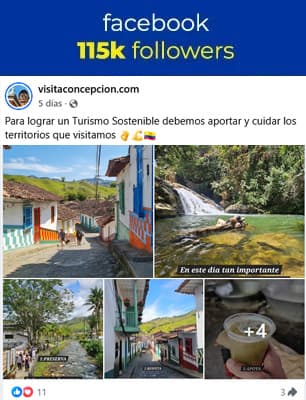
Some of the beautiful pools and streams in Concepción, Antioquia, where fish such as sabaleta can be found. From left to right: Charco Negro (Palmichal hamlet), Charco el Brujo (road to Alejandria), and Charco Aguacate
The Eastern Antioquia region, located in the Central Andes of Colombia, is characterized by a wide altitudinal gradient and great water richness, with most of its watersheds draining into the middle Magdalena River basin. From a taxonomic point of view, 103 species belonging to eight orders and 25 families have been recorded. The families with the greatest diversity are Characidae, Astroblepidae, Loricariidae, and Trichomycteridae. Finally, it is important to note that the ichthyofauna (fish fauna) in Antioquia is still largely unknown compared to other regions.
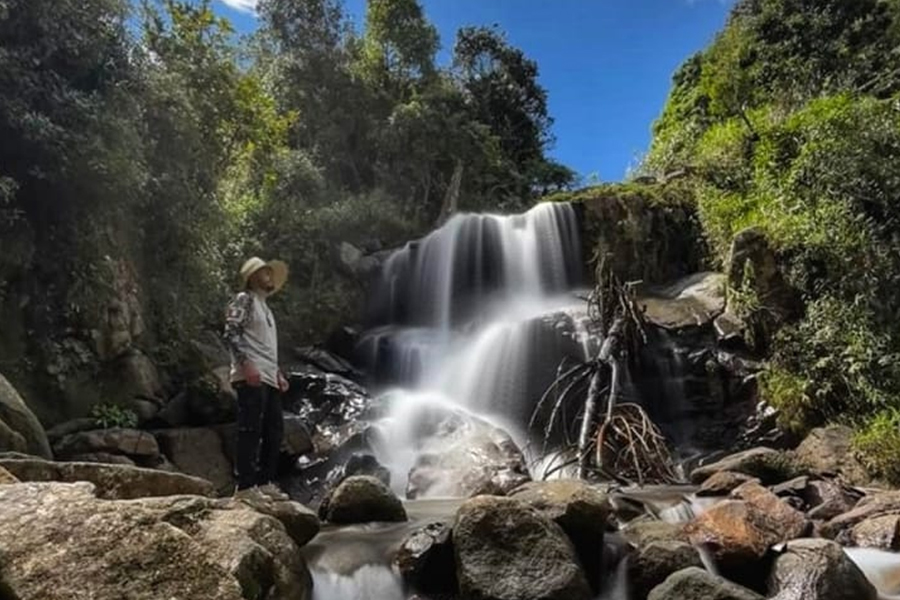
The beautiful Matasano stream, near the Santa Ana hamlet: an important water source for the municipality
The temperature of the rivers in Concepción ranges from 12 to 23 degrees Celsius, with optimal conditions of cleanliness and purity. This is why Sabaleta and Capitán inhabit these areas, which are rich in oxygen and food. Thanks to Tiempo de Pesca, a popular venture by the fisherman Juan Diego Monsalve, and the current representative of the Tourism Office, Paola Zuluaga (who provided these beautiful photos we are sharing), we have summarized the most representative aquatic fauna as follows:
SABALETA
Brycon henni is a fish species of the Characidae family in the order Characiformes. It is endemic to Colombia and Ecuador and is commonly known as sabaleta. Undoubtedly, it is the most famous fish of Concepción, Antioquia, found abundantly in both the Concepción River and all the nearby streams of the municipality, from the Planta area (near the Casa de la Cultura) to the Nare. It makes short migrations of up to 100 km to lay its eggs.

It is a species endemic to the Central Andes of Colombia (Cauca River, the eastern slope of the Magdalena River, in the San Jorge and San Juan rivers). In the Porce River basin, it has been found in all aquatic systems: river channels, tributary streams, and the Porce II and Porce III reservoirs. The Sabaleta population in the latter sector of the Porce River prefers fast-flowing waters over rocky and gravel substrates, with riparian vegetation composed of grasses, shrubs, and trees, providing good shading for the channel.

Charco Ahogao or Dolores, one of the hundreds of places in Concepción where Capitán or Black Fish can be found. Downstream from La Planta, Sabaleta can be found in abundance
It is a medium-sized fish. Males can reach up to 35 cm in total length and 470 g in weight. In the Porce River basin, it has an average standard length of 81 mm (range: 25 – 263). Its body is fully scaled and has all fins. The anal fin is short with 21–24 soft rays. Specimens captured in the Porce River basin have a slightly reddish caudal fin with a diffuse black spot at the base of the caudal fin rays extending to the fin tip, while the other fins have no coloration. It has a black opercular spot and a red spot on the upper part of the eye. Teeth are present in both jaws.

It is an omnivorous species, feeding mainly on insects, plant material, seeds, and macroinvertebrates; primarily mayflies, flies, and caddisflies, as well as crustaceans and fish. It reproduces during the rainy season, mainly in the streams. Concepción has worked hard to preserve the Sabaleta, being the only municipality in Colombia to designate a protected area where fishing is prohibited—from the upper basin near the Arango Bridge to the town center. Fishing is allowed only for scientific purposes with prior authorization under an agreement between Cornare (Regional Corporation of Eastern Antioquia, dedicated to environmental protection), Politécnico Isaza Cadavid, and the Municipality.
CAPITÁN OR BLACK FISH
Hypostomus plecostomus is a well-known fish of the order Siluriformes, native to South America, and belongs to the catfish family. It can be found from Costa Rica to Argentina, particularly in the Dominican Republic, Peru, Panama, Colombia, Venezuela, Ecuador, Argentina, Uruguay, Paraguay, and Guyana.

Colloquially, it is known as algae-eater, glass cleaner fish, devil fish, catfish, glass sucker, stone sucker, pleco, water elder, and many other names. It swims in rivers and streams. Alexander von Humboldt discovered this small whiskered fish, a little over 20 cm long with a dark green and black body, endemic to the savanna. Water pollution, forced relocation to various lagoons, and improper fishing have pushed it to the brink of extinction.
In the wild, it can reach 70 cm and live up to 15 years. It is omnivorous and nocturnal, staying still or hidden during the day. Relatively calm but territorial with other bottom-dwelling fish, it comes out at night to feed. Unlike other fish, this species has no scales. Instead, it protects its body with cartilage and spines, which it uses in fights with other fish and animals. Highly valued by the locals of Concepción for family consumption, it lives close to rocks and prefers cold water and dark pools.
CORRONCHO OR GUABINA
Guabina or Corroncho is a freshwater fish belonging to the family Erythrinidae. It is abundant across most of the Americas, with a wide distribution from Central America to Argentina, including the Antilles, Colombia, and Venezuela.

In Concepción, it can be found in streams or ponds. Males can reach up to 30 cm. Its body is elongated, rounded with a taper toward the tail, covered with small scales. Its head shows a large mouth and small eyes positioned on top. The fins are rounded, making it an excellent swimmer. The general coloration is brown with dark spots, allowing it to easily camouflage with the bottom.
REJO
Trichomycterus dispar is a species of fish in the family Trichomycteridae, order Siluriformes. Commonly called “rejo,” it inhabits ponds or streams of the main river basin and serves as food for other species, particularly Sabaleta.

This genus is defined by the lack of distinctive specializations, being undoubtedly polyphyletic (an artificial grouping of separate branches of the evolutionary tree). It is poorly defined, and for many species only brief descriptions exist. Many species have been recently described, and many more remain to be identified.
SARDINE
Sardina pilchardus is a species of clupeiform fish in the family Clupeidae. It is the only species in its genus and is closely related to anchovies and herrings.

Its body is elongated, not very compressed. The upper jaw is slightly or not notched. The maxillae do not extend beyond the middle of the eye. The eye has a well-developed adipose eyelid. Teeth are small or absent. The dorsal fin originates closer to the head than the base of the caudal fin. The pelvic fins are positioned abdominally in the middle of the ventral region under the dorsal fin. The operculum has radiating striations. The back is dark gray, blue, and silver, with a bluish band along the sides. The belly is silvery white. The fins are colorless, except for the dorsal fin, which is slightly darkened.